vocabulary of a language
As every experienced language learner knows, the first step is often learning the grammar, syntax, and how sentences are put together. But to truly succeed in mastering a language, one faces the massive additional task of learning vocabulary. This is particularly challenging for non-Western languages like Arabic, Chinese, and Japanese, where there are essentially no cognates and the student must learn every word on a “clean slate”. To conquer this “hard part” of language acquisition, you need a high-performance system of language learning flashcards.
Beyond Passive Recognition: No Multiple Choice
Many digital study tools rely on passive recognition, but understanding, speaking, and reading are not multiple-choice tasks. Serious Language Student language learning flashcards are built for rigorous, active production; practice is never multiple choice. This ensures that you aren’t just guessing from a list, but are actually mastering the vocabulary through active recall.
Science-Backed Personalization
Your progress through the vocabulary is entirely personalized based on research into effective learning curves. The system uses an algorithm to track your performance on every card:
- Successful responses: The frequency with which that card is presented is decreased.
- Review needed: If you struggle with a word, it is presented more frequently until it is mastered.
Active Mastery of Characters and Tones
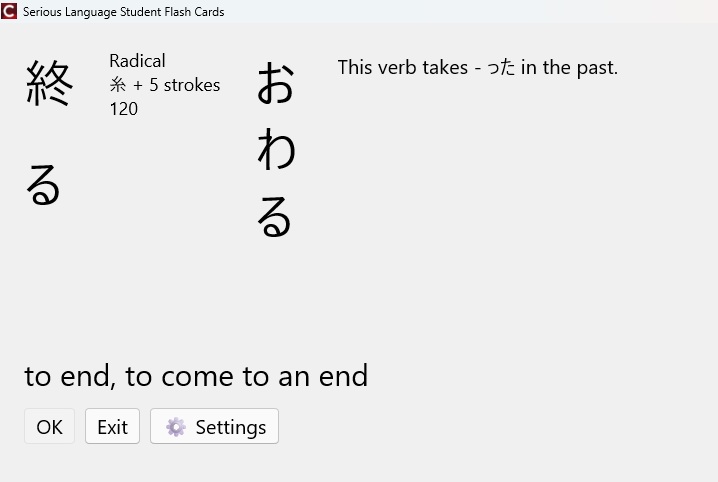
For Chinese and Japanese, these language learning flashcards go beyond simple definitions to ensure active character mastery.
- Character Description: You will learn to describe characters using a 2,000-year-old system standard in Asia, allowing you to know them well enough to write them from memory. For example, the character 桜 (cherry) is analyzed as “tree” on the left plus six additional strokes.
- Mandatory Tones: In Chinese, tones are treated as vital components of the word. You are required to include tones whenever writing pīnyīn, ensuring you don’t confuse words like shí (stone) and shì (city).
- Logical Progression: Words are introduced in a methodical sequence—moving from phonetic recognition to active production, and finally to complete spoken and written mastery in kanji or hànzì.
Advanced Grammar and Real-World Arabic
For Arabic learners, the flashcards include critical grammar points like feminine markings and broken plurals (e.g., kibaar). To prepare you for the real world, you will practice reading Arabic as it appears in the speaking world—without voweling—while being required to write with voweling to ensure perfect pronunciation.
Total User Control and Customization
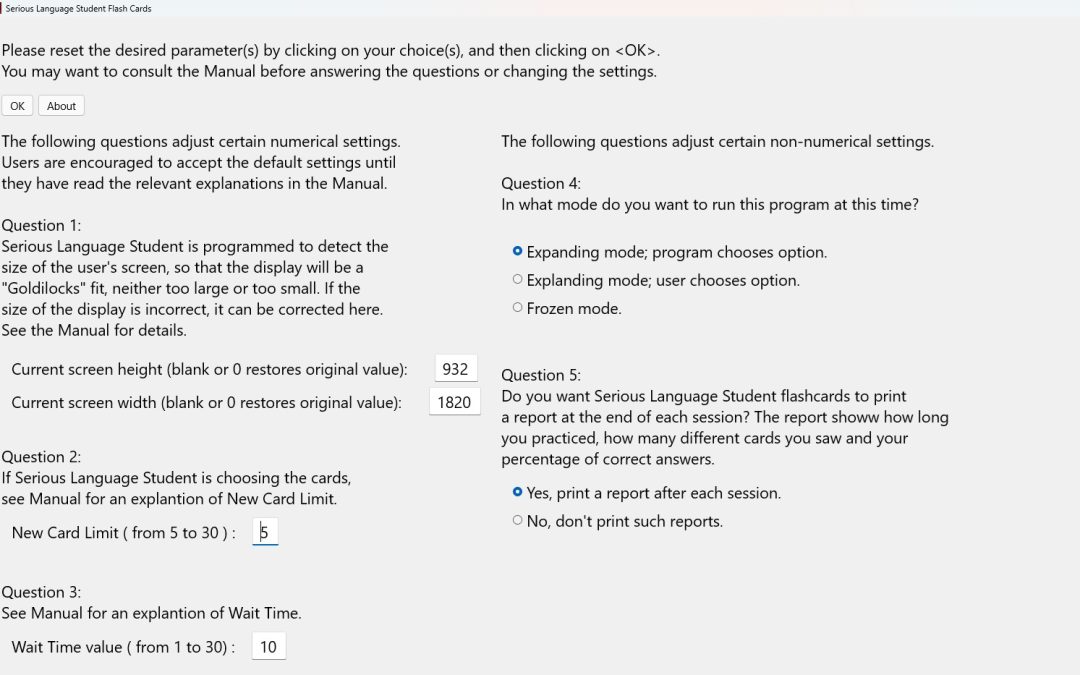
One of the most unique features of this system is the ability to add your own vocabulary words. Whether you encounter an interesting word in your independent reading or need to include specific terms from a teacher or textbook, you can expand the existing corpus of 1000+ words.
- Textbook Coordination: You can override the default order of introduction to perfectly align with any curriculum or literature you are studying.
- Quiz Mode: If you are preparing for a test, you can set the program to “quiz mode” to drill a fixed set of words without expanding your vocabulary further until the test is over.
Technical Reliability: Practice Anywhere
Because the program and your progress live entirely on your device, you never have to worry about an internet connection or losing your records in the “cloud”. These language learning flashcards provide a stable, offline environment for serious study, with the added benefit that optional updates are free and no software upgrades are ever forced upon the user.
Master the vocabulary of a language like Arabic, Chinese, or Japanese with Serious Language Student. Our high-performance flashcards use active production and personalized learning curves—with no multiple choice—to ensure you conquer the “hard part” of non-Western languages