Serious
Language Student
Home
Help
中文
(Chinese)
Serious Language Student flashcards offer you the following:
-
Users are methodically introduced to 1000+ words of common Chinese vocabulary.
-
Progress through the vocabulary is personalized to the user. As the user responds to a flashcard successfully, that card is presented less frequently. If the user needs to review that card, it is presented more frequently. The formula on which the frequency of card repetition is based flows from research on effective learning curves.
- The Flashcards program lives on the user’s device. One does not need to be connected to the Internet to run the program and practice. One is not affected by the speed of one’s Internet connection. One’s progress is recorded on one’s device, so one is protected from the records ever being “lost in the cloud.”
- words are introduced:
first Chinese in 拼音(pīnyīn)to English e.g., gǒu to “dog,”
then English to Chinese in 拼音(pīnyīn), e.g., “dog” to gǒu,
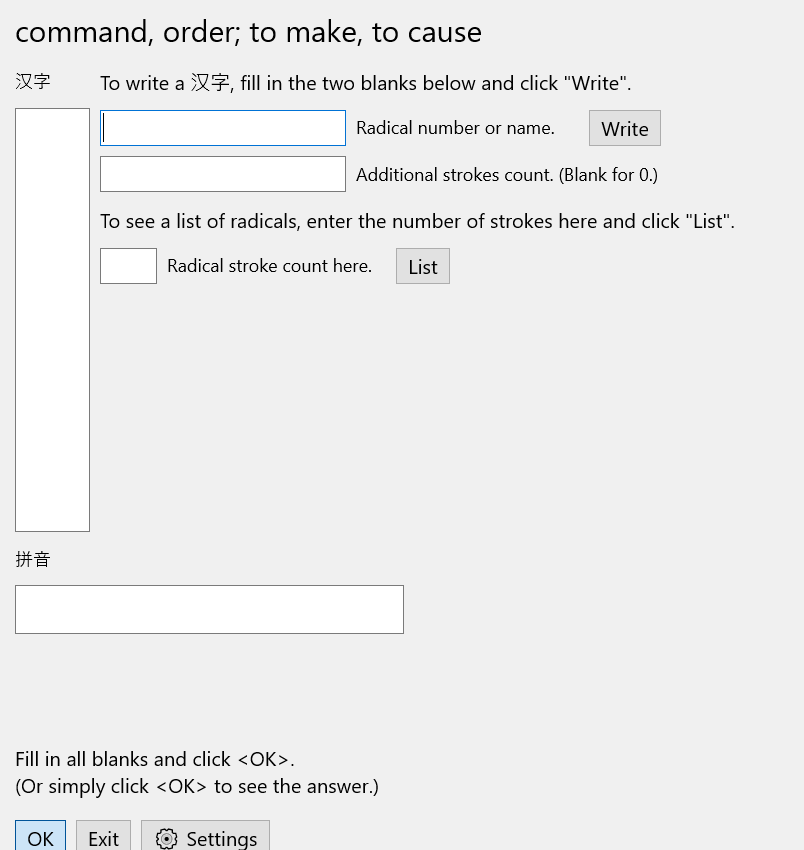
then Chinese in 汉字 (hànzì) to 拼音(pīnyīn) and English, e.g., 狗 to gǒu and “dog”, and
then English to Chinese, e.g., “dog” to 狗 and gǒu. - Practice is never multiple choice. Understanding, speaking, and reading Chinese are not multiple choice tasks. (Do other products use multiple choice?)
- The tone of a Chinese syllable is as important as its initial consonant or its final. 石 (shí) “stone,” 市 (shì) “city” and 矢 (shǐ) “arrow” are as different as “put”, “pet” and “bet” in English. Whenever the Serious Language Student flash cards show 拼音(pīnyīn), the tones are included, and whenever the users write 拼音(pīnyīn), they must include the tones. (Do other products show and require tones?)
- In learning Chinese vocabulary, there is a tension between learning words and learning characters. There are single character words which are rare, but the character is a common component of longer words or is a component of other common characters. The Serious Language Student flash cards balance these two aspects of learning Chinese. The 1,000 words chosen for the Serious Language Student’s flashcards reflect frequency studies of a variety of different corpora. However, certain one syllable words were included, even when their inclusion was not completely justified by their frequency. For example, the radicals that occur in the words used by the Serious Language Student, to the extent that they are themselves words, are included, unless they are extremely uncommon. For example, both 刀 (dāo) “knife” and 禾 (hé) “standing grain” are included, even though they are not particularly common, to facilitate the user’s learning their use as radicals. Similarly, some not very common monosyllabic words are included, because they are used in very common multisyllabic words. Thus, for example, 持 (chí) “to hold, to maintain, to keep,” although not so common, is included to faciliate the learning of such very common words as 支持 (zhīchí) “to support, to back up” and 坚持 (jiānchí) “to persist, to persevere.”
- The Serious Language Student flashcards are designed to make sure that the student not only know characters passively, i.e. can recognize them, but also actively, i.e., knows them well enough to describe them, which in general means knows them well enough to write them. (Are other products restricted to passive learning of characters?)
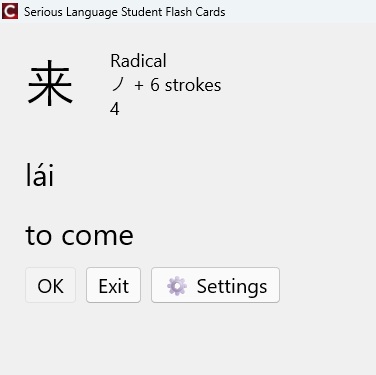
- For describing characters the Serious Language Student flashcards use the system that has been standard in China for almost 2,000 years, a system familiar to all literate Chinese and with which every student of Chinese, sooner or later, must become familiar. The specific system used by the Serious Language Student is the one that was standardized in China in the early 1700s, and which is familiar not only to all Chinese but throughout Asia whereever Chinese characters are known, e.g., Korea, Japan and Viet Nam. More details are provided in the Manual. An example would be that the character 是 (shì), “to be”, is analyzed as having the character for 日 (rì), “sun” on top plus 5 additional strokes below.
-
Users can override the order in which new vocabulary is introduced in order to adapt to the order of vocabulary introduction of any teacher or textbook. (Do other products have this adaptability?)
- Users can combine a teacher or textbook’s order of introducing new words with the order in which Serious Language Student introduces them by allowing Serious Language Student methodically to expand beyond the teacher or textbook, if the teacher or textbook words are being mastered well.
- Users who are coordinating use of Serious Language Student flashcards with a language course can set Serious Language Student to quiz mode in order to drill a certain set of words with no expansion of vocabulary but staying with the drill of only those words. After the drill or test Serious Language Student can be toggled back to gradual vocabulary expansion. (Do other products have this quiz concentration option.)
-
Users can add vocabulary words in addition to the 1000+ words with which Serious Language Student comes supplied. Thus, users working with a teacher or textbook as well as users reading on their own can add to the vocabulary list all the vocabulary introduced by that teacher or textbook or interesting words encountered in reading. Users then practice those added words as part of the Serious Language Student practice. (The ability to add words to the vocabulary corpus appears to be unique to Serious Language Student.)
Chinese Manual
Click here
Licensing Conditions
Click here
Go To
Download Instructions
Be sure to read all those
instructions carefully.
Failure to follow the instructions
may result in the forfeit of your payment.
Click here
View a
Sample Flashcard
Resource Links
Unicode home page
https://unicode.org/charts/
Uniwriter home page
https://www.unitype.com/globalwriter.php
Wiktionary home page
https://en.wiktionary.org/wiki/Wiktionary:Main_Page
Click image to enlarge
Serious Language Student flashcards
The provided texts advertise a product called Serious Language Student flashcards, which is a vocabulary learning program specifically targeting non-European languages such as Arabic, Chinese, and Japanese. These flashcard programs emphasize vocabulary acquisition, which the source material identifies as the most difficult component of learning these languages.
Browser searchable summary: Elevating Chinese Language Learning
The hard part of Chinese language learning is the acquisition of vocabulary, which includes mastering characters and learning tones. Tones are as essential to a word as its initial or its final. When one learns Chinese, one is essentially working with a “clean slate” because there are virtually no cognates with Western languages.
- Active Character Mastery: These language learning flashcards ensure one moves beyond passive recognition to achieve active mastery. One achieves active mastery by learning to describe characters using the standard system used in China for almost 2,000 years. This system was standardized in the early 1700s. For example, the character 是 (shì), “to be”, is analyzed as having the character for 日 (rì), “sun” on top plus 5 additional strokes below.
- Mandatory Tones: In this program, the tone is treated as equally important as the consonant or final. Whenever one writes pīnyīn, tones are required, ensuring one doesn’t confuse distinct words like shí (“stone”) and shì (“city”).
1. Tailored for the Experienced Language Learner
The experienced language learner understands that true fluency requires a deep, production-based approach rather than simple recognition.
- No Multiple Choice: Practice is never multiple choice because understanding and speaking Chinese are active tasks, not multiple-choice ones.
- Personalized Progress: One’s advancement through the vocabulary of the Chinese corpus is managed by a formula based on effective learning curves. Successful answers decrease a card’s frequency, while difficult ones appear more often.
- Logical Progression: Words are introduced in a four-step sequence: pīnyīn to English, English to pīnyīn, hànzì to pīnyīn and English, and finally English to hànzì and pīnyīn.
2. Customizing the Vocabulary of a Chinese Program
A hurdle in mastering languages is aligning one’s study tools with a specific curriculum.
- Add One’s Own Words: A unique feature of SLS is the ability to add vocabulary words to the provided 1000+ word list. This allows one to include interesting words found in independent reading or specific terms from a teacher or textbook.
- Textbook Coordination: One can override the order of introduction to coordinate with a textbook.
- Test Preparation: If one is taking a course with testing, one can use “quiz mode” (or “frozen mode”) to drill a specific set of words, returning to the expansion of vocabulary later.
- Strategic Radical Inclusion: The core vocabulary of a Chinese student must include radicals like 刀 (dāo) “knife” or 禾 (hé) “standing grain” to facilitate learning more complex characters later.
3. Technical Reliability for the Student
The technical implementation of these language learning flashcards ensures one’s study is never interrupted:
- Offline Access: The program lives on one’s own device; one does not need an Internet connection to practice.
- Local Records: Progress is saved on one’s own device, protecting one from losing language records in the cloud.
- Freedom From Upgrades: Since the program lives on one’s own device, there is never any need to perform an upgrade. Optional updates are free with the initial license, excepting upgrades that actually expand the vocabulary.