Serious
Language Student
Home
Help
日本語
(Japanese)
Serious Language Student flash cards offer you the following:
-
Users are methodically introduced to 1100+ words of common Japanese vocabulary.
-
Progress through the vocabulary is personalized to the user. As the user responds to a flashcard successfully, that card is presented less frequently. If the user needs to review that card, it is presented more frequently. The formula on which the frequency of card repetition is based flows from research on effective learning curves.
-
The Flashcards program lives on the user’s device. One does not need to be connected to the Internet to run the program and practice. One is not affected by the speed of one’s Internet connection. One’s progress is recorded on one’s device, so one is protected from the records ever being “lost in the cloud.”
-
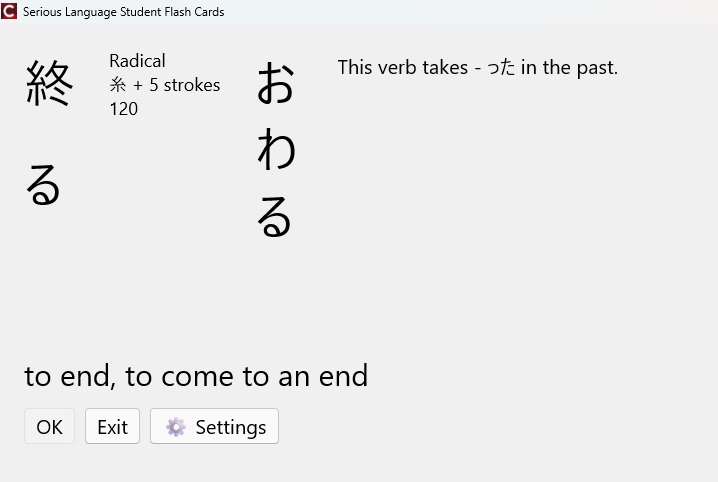
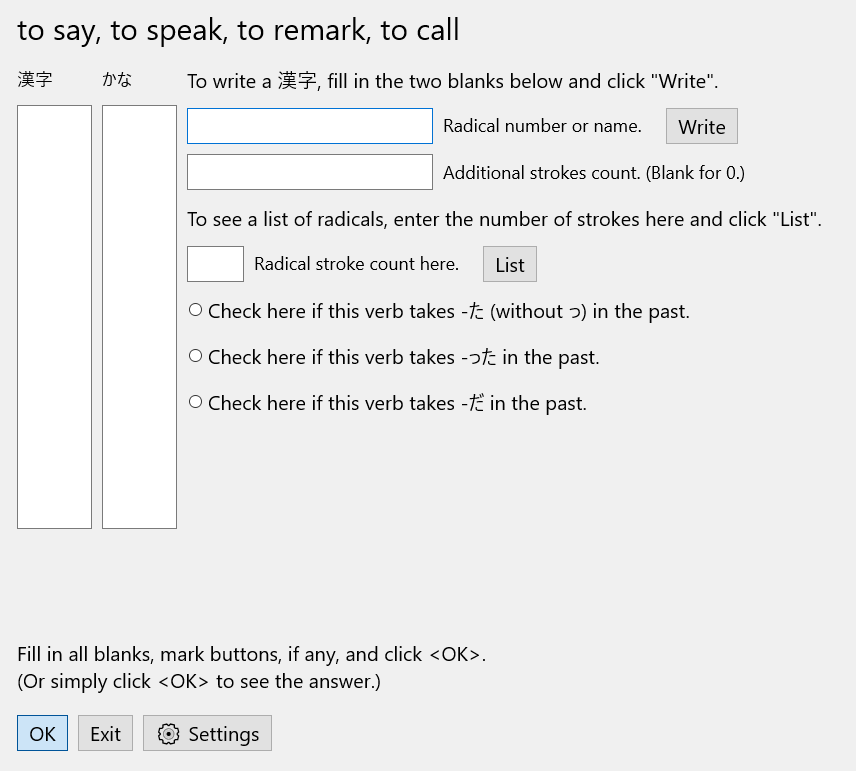
The Serious Language Student flashcards are designed to make sure that the student not only know characters passively, i.e. can recognize them, but also actively, i.e., knows them well enough to describe them, which in general means knows them well enough to write them. (Are other products restricted to passive learning of characters?)
-
For describing characters the Serious Language Student flashcards use the system that has been standard in China for almost 2,000 years, and which was adopted in Japan, when the Japanese adopted characters. It is a system familiar to all Japanese and with which every student of Japanese, sooner or later, must become familiar. The specific system used by the Serious Language Student is the one that was standardized in China in the early 1700s, and which is also the standard in Japan. More details are provided in the Manual. A quick example here is that the character 桜 (さくら) “cherry” is analyzed as consisting of the character 木 (き) “tree” on the left plus six additional strokes. The user of Serious Language Student flash cards will learn this system of describing characters, known and used by all Japanese.
-
When learning Japanese vocabulary, there is a tension between learning the most common words versus learning the most common characters. The two are not the same thing. For one example, 的 (まと) “target” is a rare word, but the character 的 with the pronunciation てき is a component of many compound words, especially as a suffix. So, the 1100+ words in the Serious Language Student flash card vocabulary are a combination of the most common words, as measured in a variety of sources, but also, very importantly, all 1006 of the so-called “education kanji,” 教 育 漢 字 (きょういくか ん じ), established by the Japanese Ministry of Education, 文 部 科 学 省 (もんぶがくしょう). These are the characters learned in elementary school by all Japanese children and certainly must be part of learning Japanese for any foreigner. Characters that have both a common Japanese reading, 訓読み (くんよみ), and a common Chinese reading, 音読み (おんよみ), appear at least twice to illustrate both, e.g., 学 appears both in 学ぶ(まなぶ) “learn” and in 大学 (だいがく) “university.”
-
Words are introduced in a logical progression,
first going from かな (phonetic Japanese) to English, e.g., いぬ to “dog,”
then English to かな, e.g., “dog” to いぬ,
then 漢字(かんじ)to English and かな, e.g., 犬 to “dog” and いぬ, and
finally, English to 漢字(かんじ) and かな, e.g., “dog” to いぬ and 犬. -
Practice is never multiple choice. Understanding, speaking, and reading Japanese are not multiple choice tasks. (The potential buyer should check whether other products use multiple choice.)
-
Users can override the order in which new vocabulary is introduced in order to adapt to the order of vocabulary introduction of any teacher or textbook. (The potential buyer should compare whether other products have this flexibilty.)
-
Users who are coordinating use of Serious Language Student flashcards with a language course can set Serious Language Student to quiz mode in order to drill a certain set of words with no expansion of vocabulary but staying with the drill of only those words. After the drill or test Serious Language Student can be toggled back to gradual vocabulary expansion. (Potential buyers should compare whether other products have this quiz concentration option.)
-
Users can add vocabulary words in addition to the 1000+ words with which Serious Language Student comes supplied. Thus, users working with a teacher or textbook as well as users reading on their own can add to the vocabulary list all the vocabulary introduced by that teacher or textbook or interesting words encountered in reading. Users then practice those added words as part of the Serious Language Student practice. (The ability to add words to the vocabulary corpus appears to be unique to Serious Language Student.)
Click here to view a video of the flashcards in use.
Click below to view a
sample flashcard
Japanese Manual
Click here
Licensing Conditions
Click here
Go To
Download Instructions
Be sure to read all those
instructions carefully.
Failure to follow the instructions
may result in the forfeit of your payment.
Click here
Resource Links
Unicode home page
https://unicode.org/charts/
Uniwriter home page
https://www.unitype.com/globalwriter.php
Wiktionary home page
https://en.wiktionary.org/wiki/Wiktionary:Main_Page
Serious Language Student flashcards
The provided texts advertise a product called Serious Language Student flashcards, which is a vocabulary learning program specifically targeting non-European languages such as Arabic, Chinese, and Japanese. These flashcard programs emphasize vocabulary acquisition, which the source material identifies as the most difficult component of learning these languages.
Browser searchable summary: Elevating Japanese Language Learning
For any student engaged in Japanese language learning, the Serious Language Student system provides a methodical introduction to over 1100 words of common vocabulary.
- The Kanji: A central pillar of the program is the inclusion of all 1006 “education kanji” (kyōiku kanji), established by the Japanese Ministry of Education. These are the essential characters learned by all Japanese children and are vital for any foreigner to master.
- Dual Readings: Characters that have both a common Japanese reading (Kun-yomi) and a common Chinese reading (On-yomi) appear at least twice to illustrate both, such as the character 学 appearing in both manabu (“learn”) and daigaku (“university”).
1. Supporting the Serious Language Learner
The language learner who has moved beyond the basics understands that while grammar is the foundation, vocabulary is the “hard part” of learning non-European languages.
- No Cognates: Aside from modern borrowings, Japanese lacks cognates with Western languages, meaning the language learner must learn all words on a “clean slate”.
- Personalized Progress: The system tracks individual performance; cards are presented more or less frequently based on the student’s successes and a formula derived from research on effective learning curves.
2. High-Performance Language Learning Flashcards
These are not standard, passive language learning flashcards. The SLS system is built for rigorous, active production:
- Active and Passive, Spoken and Written Mastery: For each word, the program proceeds methodically. First, the student learns to recognize the word (passively) as written in kana. Next, the student shows active knowledge by going from English to kana. After the spoken word is mastered, one learns to recognize the word written in kanji, and finally, the student shows complete knowledge by going from English to both kanji for writing and kana for speaking.
- Active Character Mastery: The system ensures one doesn’t just recognize characters passively; one must know them well enough to describe and write them. To do this, one learns the standard, ancient system for describing characters—standardized in China in the early 1700s—such as analyzing 桜 (“cherry”) as the character for “tree” on the left plus six additional strokes.
- Production Over Choice: Practice is never multiple choice because understanding, speaking, and reading Japanese are active, not reactive, tasks.
- Technical Reliability: These language learning flashcards live on your device, allowing for offline practice and protecting your progress from being “lost in the cloud”.
- Freedom From Upgrades: Since the program lives on your own device, there is never any need to perform an upgrade. Optional updates are included in the cost of the initial license, excepting those that expand the vocabulary.
3. Mastering Languages and Vocabulary Expansion
To succeed in mastering languages, a student needs a comprehensive vocabulary of a language that matches their specific goals.
- Custom Vocabulary Corpus: A unique feature of this program is the ability to add one’s own vocabulary words encountered in textbooks or independent reading.
- Textbook Coordination: One can override the program’s built-in order of introducing new words to align the language learning flashcards with a specific teacher’s curriculum, a textbook, or a piece of literature.
- Focused Drill: The “frozen mode” (or quiz mode) allows one to drill a fixed vocabulary of a language set to prepare for a test before returning to gradual vocabulary expansion.